 Ingest
Ingest / Shortcuts
Find it with ⌘K. Make it your own.
Search for anything you want to do in Ingest. The Command Palette gives you access to app actions without memorizing shortcuts. Learn the keys you use most and customize them in Settings.
To show the shortcut overlay, tap and release ⌘, then press it again and hold. A single long hold does not open it. Settings offers an enable switch and 600, 900, or 1,200 ms second-hold delay. Quick Tips can teach current custom shortcuts as you work; disable teaching or reset its learning in Browsing Settings.
How to read this
⌘ is Command, ⌥ is Option, ⌃ is Control, and ⇧ is Shift. A key written on its own, like T, is pressed on its own.
Some keys mean different things depending on where you are. In the file browser, there are three places: the grid of thumbnails, the large preview, and a video playing in the preview. Where a key only works in some of them, the table says so. Apple Photos and Social Export have their own contextual commands.
Single letters pause whenever you are typing. If the cursor is in the keyword field, T types a letter t. Press Esc to leave the field and the keys come back.
A command that cannot run right now does not fail quietly. It beeps and the status bar says why, for example that nothing is tagged, or that the source is read only.
Keys that never change
These move you around and open things, so they are not available for rebinding. Settings lists them too, so nothing about the keyboard is hidden.
| Keys | What they do |
|---|---|
| ← → ↑ ↓ | Move between photographs; when zoomed, pan the current photo. Hold ⇧ to extend the selection, hold ⌘ to move the focus without changing the selection. |
| Space | Open or close the preview. On a video, play or pause. |
| ↩ | Open or close the preview. |
| Esc | Dismiss the innermost popup or editing interaction, then leave Compare or Review. Escape does not close an idle standalone editor. |
| Tab | Hide or show both side panels at once. |
| ⌥Tab | Next split. ⌥⇧Tab goes back. |
| Home End | First and last photograph. |
| Page Up Page Down | Previous and next photograph. |
| J K L , . M | In a video: shuttle back, play or pause, shuttle forward, step a frame back, step a frame forward, mute. |
Marking
By default a marking key acts where you are and does not move on. Turn on advancing in Settings → Browsing, and then holding ⇧ does the opposite for one press. The command names in the app flip to match, so the menu always tells the truth.
| Keys | Command | Where |
|---|---|---|
| T | Toggle tag | Grid, preview, video |
| ⇧T | Tag and advance, or tag without advancing | Grid, preview, video |
| U | Untag | Grid, preview, video |
| R / ⇧R | Mark Reviewed; Shift reverses the review advance preference | Files and Apple Photos |
| no key | Mark Unreviewed; Protect / Unlock Photos | Files and Apple Photos |
| ⌫ | Delete selected photos; confirmation is on by default | Grid, preview, video |
| 1 … 5 | One star to five stars. Pressing the rating it already has clears it. | Grid, preview |
| ⇧1 … ⇧5 | The same, with the opposite advance behavior | Grid, preview |
| 0 | Clear the rating | Grid, preview |
| 6 7 8 9 | Label red, yellow, green, blue. The Lightroom keys and the Lightroom names. | Grid, preview |
| ⇧6 … ⇧9 | The same, with the opposite advance behavior | Grid, preview |
| ⌥9 | Label purple | Grid, preview |
| ⌥0 | Clear the label | Grid, preview |
| no key | Clear all tags, with a confirmation |
Tag, rating, label, and review actions have separate advance settings. With multiple photos selected, T tags all of them, or clears their tags when all are already tagged. Viewing alone does not mark a photo reviewed. Protected photographs are skipped with an explanation.
A mark applies to every selected photograph, or to the one under the focus ring. On a collapsed bracket stack it applies to every frame in the stack.
Views and overlays
Review has no assigned key by default. Open it from the photo-control row or ⌘K. It keeps a fixed queue: marking a photo does not remove it. In Review, [ and ] inspect faces when face inspection is active; elsewhere they navigate groups. In Compare, arrows and marks follow the comparison context described below.
| Keys | Command | Where |
|---|---|---|
| ⌘1 ⌘2 ⌘3 | Grid, preview, split | |
| Space | Toggle the preview | Grid, preview |
| ⌘I | Show or hide the right sidebar | |
| ⌥⌘S | Show or hide the left sidebar | |
| Tab | Hide or show both sidebars | Browse |
| C | Open Select/Candidate. Left/right browses candidates; Up makes Candidate the Select; Down swaps. Marking acts on the active pane; Esc returns to the previous view with Select selected. | Grid, preview |
| N | Survey the whole current stack, twelve frames per page, or up to six selected photographs. Stack double-click opens the same grid. | Grid, preview |
| I | Cycle the information overlay: off, basic, full | Grid, preview, split |
| ⌥D | Detail overlay, to judge sharpness | Preview |
| ⌥E | Focus Peaking | Preview |
| ⌥A | Show the focus point the camera recorded, when it recorded one | Preview |
| ⌥F | Subject Close-ups: faces, detected subjects, or a labeled center fallback | Preview |
| ⌘+ ⌘- | Bigger and smaller thumbnails | Grid |
| F | Enter or exit Focus Mode | Active workspace |
| ⌃⌘F | Full screen | |
| ⌥⌘F | Put the preview on a second display | |
| ⌥⌘J | Combine RAW and JPEG / HEIF pairs into one photograph, for this folder | |
| ⌥⌘K | Stack bracket sets, for this folder | |
| ⌃1 … ⌃9 | Switch to a workspace | |
| no key | Sort by capture time, filename, rating, color label, visual appeal, date modified, or file size | |
| no key | Sort by album order | Apple Photos |
| no key | Sort by group order | Organize |
| no key | Reverse the sort order | |
| no key | Hide Both Sidebars / Show Both Sidebars (search “sidebar” in the Command Palette) | All workspaces |
| [ ] | Previous and next face while face inspection is active; otherwise the previous and next group, scene, or Photo Suggestions set | Grid, preview |
| no key | Group by Day, Camera, Lens, ISO or Location; Clear Grouping. Click the group bar or any heading to jump to a group. | Group control |
| no key | Manage keywords everywhere at once |
Hold B to temporarily inspect Select, or the first tagged frame in the current group outside Compare. Release restores the previous view. Hold Z over a grid thumbnail to inspect it without selecting it; release dismisses the loupe. The View menu offers persistent Grid Loupe activation.
Zoom
All of these work in the preview. Zoom is anchored on the pointer, so the detail under the cursor stays under the cursor.
| Keys | Command |
|---|---|
| Z | Switch between fit and 100% at the pointer; in Social Export, show the exported file at 100% |
| ⇧F | Fit to the window |
| ⌥1 ⌥2 ⌥4 | 100, 200, and 400 per cent |
| ⇧Z | Lock or free zoom across Survey panes. Select/Candidate has a Linked Zoom control inside its view. |
A pinch on the trackpad zooms around your fingers, a two finger drag pans, and a two finger double tap does what Z does. In the grid, a pinch resizes the thumbnails.
Selecting and filtering
| Keys | Command |
|---|---|
| ⌘A | Select all |
| ⌘D | Deselect all |
| ⇧⌘I | Invert the selection |
| ⌘T | Select everything tagged |
| ⇧⌘T | Show only what is tagged |
| ⇧⌘1 … ⇧⌘5 | Show only photographs rated that many stars or more |
| ⇧⌘0 | Clear the star filter |
| ⌘F | Put the cursor in the filter field |
| ⌥Tab ⌥⇧Tab | Next and previous split |
| ⇧⌘S | Save the current filter as a split |
Click to start a new selection, ⌘ click to add or remove one, ⇧ click to add an anchor-to-click range while preserving earlier selections. ⌘ with an arrow key moves the focus ring without changing what is selected, which is how you reach past a selection without losing it.
Stacks
| Keys | Command | Where |
|---|---|---|
| S | Expand or collapse the stack you are on | Grid, preview |
| ⌥S | Expand or collapse every stack | |
| P | Keep This Frame: add a tag without clearing other keepers, and collapse the stack | Grid, preview |
| ⇧P | Sharp Enough / Restore Detail Warning. Clears or restores the detail warning on selected photographs | Grid, preview |
| no key | Create Scene from Selection; Move to Scene; Combine Scenes; Rename Scene. Each previews the full photo count and supports Undo. | |
| no key | Keep Only This Frame; Previous/Next Burst; Review Scene; Previous/Next Scene; Photo Suggestions, which shows each set of similar shots with its suggested photo (↑ ↓ between sets). Suggestions change no decisions until you choose Tag. | |
| no key | Analyze Photos, or stop the pass; Compare RAW and JPEG, Apple’s neutral rendering beside the camera JPEG | |
| no key | Combine the selected photographs into a stack. With nothing selected, it puts back the stacks you took apart in this view. | |
| no key | Uncombine. Stacks in the selection, or the one you are on, or every stack in this view. |
Metadata
| Keys | Command | Where |
|---|---|---|
| ⌘’ | Open Metadata Assist: type ; to see field options, review values, then apply | Files and import |
| ⇧⌘C / ⇧⌘V | Copy selected metadata groups / paste copied metadata | Files |
| Tab | Fill the highlighted field, code, or previously used value | Metadata Assist writing area |
| Q | Quick Entry syntax in Metadata Assist. One line that can set keywords, a rating, a label, a caption, a location, and a preset at once. | Grid, preview |
| K | Put the cursor in the keyword field | Grid, preview |
| ⇧K | Take back the keywords you just added | Grid, preview |
| ⇧C | Put the cursor in the caption field | Grid, preview |
| M | Choose a metadata preset to apply | Grid, preview |
| ⇧⌘M | Apply the preset you used last | |
| ⌘L | Set location from an address, GPS coordinates, or city/state | |
| ⇧⌘L | Strip the location back out | |
| ⌥⌘[ ⌥⌘] | Rotate left and right, by changing the orientation flag rather than the pixels | |
| ⌥⌘T | Adjust capture time, for when two cameras disagree about the clock | |
| no key | Crop & Straighten opens an editor inside Preview. Copy Crop and Paste Crop to Selection reuse a composition. | Writable files |
| no key | Apply the current location to the selection, to everything tagged, or to everything |
The quick entry syntax is on the templates page.
Files and ingest
⇧⌘E sends the current selection to an independent Social Export project. ⌘E opens its export sheet. Browse keeps ⌘E for Eject. Choose File → Social Export… with no selection to resume. Sending photos to a populated editor offers New Project, Add to Current, or Cancel. Inside Social Export, arrows select frames, or nudge a selected photo by one exported pixel (⇧ for ten). Z shows the exported file at 100%. Esc steps back out of that view, then out of the selected photo, without closing the editor window. Use ⌘W to close an idle editor and save its draft. ⌘Z/⇧⌘Z undo or redo composition edits. Text fields retain native editing shortcuts.
| Keys | Command |
|---|---|
| ⇧⌘E | Send to Social Export… |
| ⌘E | Export in Social Export; eject a card in Browse |
| ⌘O | Open a folder |
| ⌘G | Open Import Settings |
| no default key | Review the selection or visible photo queue; configurable in Settings |
| ⌘W | Close the current Browse tab, or the focused idle editor window |
| ⌘Y | Copy to a folder, without the rest of the ingest machinery |
| ⌘R | Rename photographs where they are |
| ⌥⌘R | Re-sequence what is shown, so the numbers have no gaps after a cull |
| ⇧⌘R | Reveal in Finder |
| ⇧⌘F | Find Folder in the Command Palette; search folder names and open a result without replacing the sidebar tree |
| ⌘Z ⇧⌘Z | Undo and redo |
| no key | Close the source |
Video
These work while a video is open in the preview, and they take precedence over the letters they share.
| Keys | Command |
|---|---|
| Space or K | Play or pause |
| J L | Shuttle backwards and forwards, faster each press |
| , . | Step one frame back and forward |
| ← → | Step a frame. Hold ⇧ to jump seconds. |
| M | Mute |
| ↑ ↓ | Move to the previous or next item, so a video never traps you |
Cards and folders
| Keys | Command |
|---|---|
| ⌘E | Eject the card |
| no default key | Add the open folder to your favorites |
| ⌃⌘1 … ⌃⌘9 | Open favorite one to nine |
| ↩ | Activate the default Import button when Import Settings is ready |
| no key | Choose All, Tagged, or Selected in Import Settings. Browse selection and import scope are separate. |
| no key | Delete tagged, or untagged, from the card, after the copies verified |
Apple Photos
These commands apply while browsing Apple Photos. File commands elsewhere in this reference apply to the file browser. Single-letter shortcuts pause while you type.
| Key | Action in Photos |
|---|---|
| G | Add selection to albums |
| R / ⇧R | Mark Reviewed / reverse the review advance preference for this press |
| H | Toggle native favorite |
| M | Review Photos metadata edits |
| T | Toggle local Ingest tag |
| 0–5 | Clear or set stars; native on macOS 27, local on earlier versions |
| Space | Toggle preview |
| Arrow keys / ⇧ + arrows | Move through photos / extend selection |
| ⌥⌘← / ⌥⌘→ | Move selection earlier / later in an editable album |
| Delete | Remove from the current editable album; keep in the library |
| ⇧⌘E | Send selection to Social Export… |
| ⌘K | Find Photos commands, including Organize, Import History, and the separate confirmed Delete from Library action |
App
| Keys | Command |
|---|---|
| ⌘K | The Command Palette |
| ? | The shortcut sheet |
| hold ⌘ | An overlay of the keys that work where you are |
| ⌘, | Settings |
| no key | Open the practice folder, to drill the keys on throwaway images |
Changing a key
Open Settings, then Shortcuts. Every command is listed with its key. Click the key and press the one you want. You can also Tab to the recorder and press Return or Space to begin. Esc cancels, and Delete removes the key so the command has none.
If the key is already taken by something that overlaps, Ingest names the other command and offers to move the key across. It refuses a key that is fixed, and it refuses the bare keys that move you around, because the app consumes those before any command sees them.
Standard Mac editing keys are reserved. Select All, Undo, Redo, and Settings retain their native shortcuts. If an older custom binding conflicts with a standard key, Settings explains the conflict and offers a reset; the saved override is kept until you change it.
While a text field has focus, ⌘A selects its text, and undo and redo stay in that editor. Photo-navigation keys do not intercept typing.
A changed key follows everywhere at once. The menus, the palette, the ? sheet, and the hold overlay all read from the same table, so there is no second place to update and nothing to get out of step. Reset All puts every key back.
Every action, one search
Find Source Summary, Select from Pick List, Export Selected Decisions, and Open Current Source in New Tab by name. Source Summary opens in the inspector; clicking a count applies a removable filter.
If you can do it in Ingest, you can find it with ⌘K—whether the action has an assigned shortcut or not. Press ⌘K and search by name, alias, or category. Switch workspaces, find a folder, tag a keeper, edit metadata, organize files, or export without navigating menus.
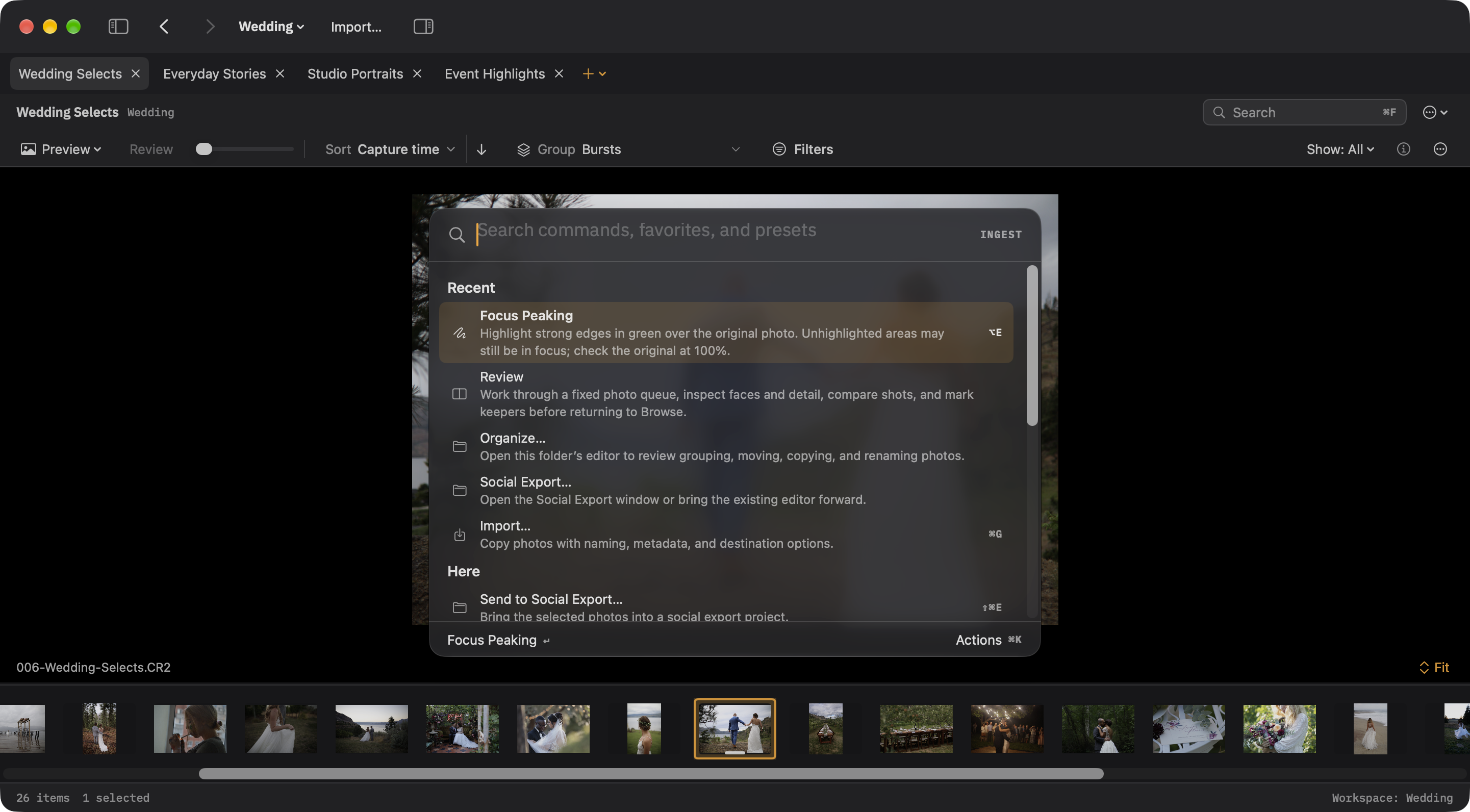
Inside the palette, ⌘K toggles Actions. Use the arrow keys and Return to choose Pin/Unpin, Copy Link, or Configure Shortcut. Esc closes Actions before it closes the palette. Configure Shortcut reveals that command in Settings; temporary card and recent-folder entries do not offer it.
The palette also lists the things that come and go: your favorites, workspaces, splits, metadata presets, actions, and recent folders. ⇧⌘P pins whatever is highlighted to the top of the list. ⇧⌘C copies a link that runs it, which is how the URL scheme is meant to be discovered.